Nominal Licensing and Agree in Syntactic Theory
The Default Feature Specification on the Phase Heads and Its Theoretical Implications
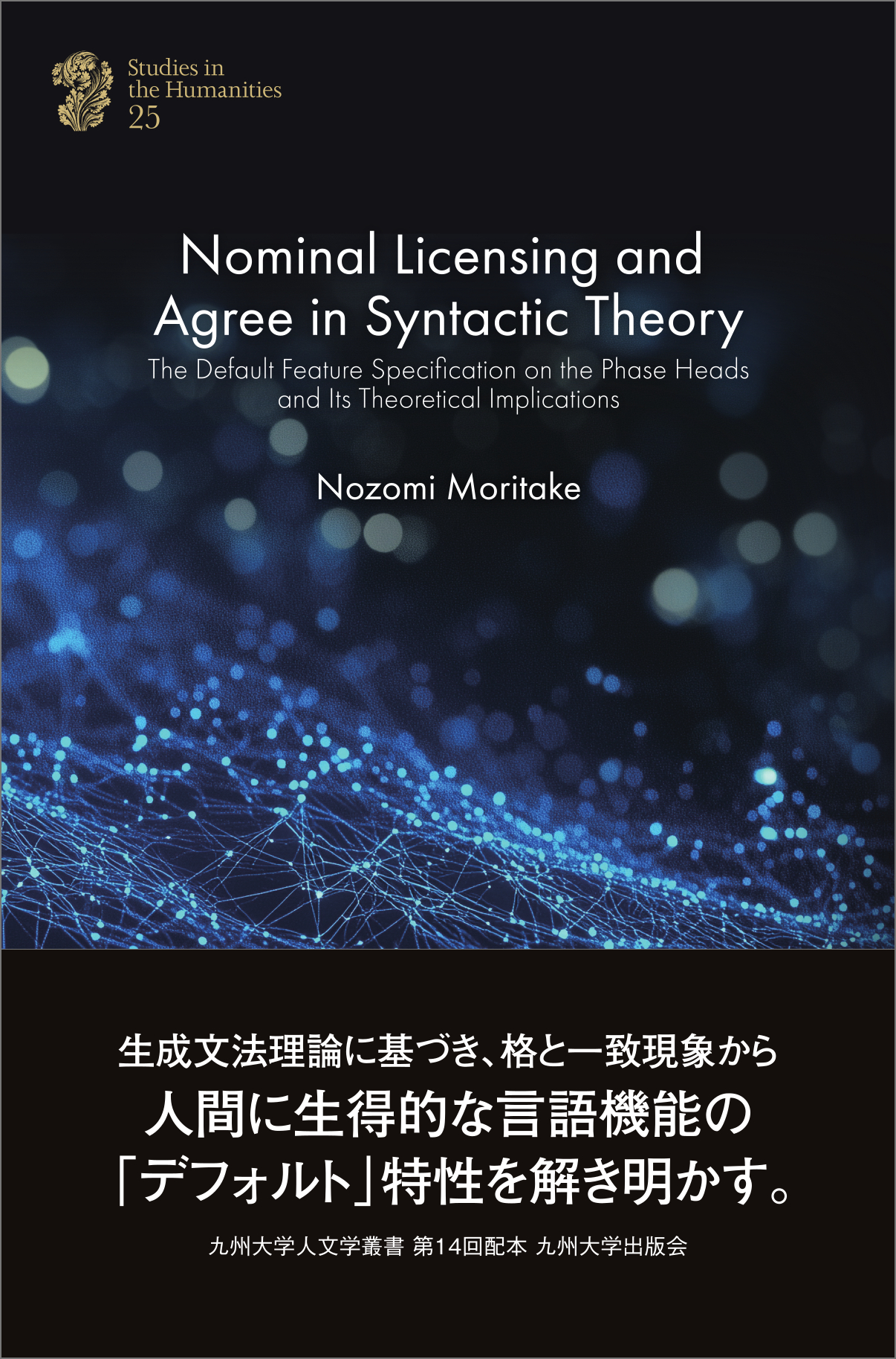
- シリーズ名
- 九州大学人文学叢書 25
- 著者名
- 森竹希望
- 価格
- 定価 11,000円(税率10%時の消費税相当額を含む)
- ISBN
- 978-4-7985-0394-3
- 仕様
- 菊判 上製 314頁 C3382
- 発行年
- 2026年1月
- ご注文
-




内容紹介
本書は生成文法理論に基づき、デフォルト格の理論的実装を行いつつ、phi素性一致の有無に基づく二種類の格付与メカニズムに加え、名詞句の統語的位置を規定する二種類の条件を提案する。そして、英語や日本語、トルコ語、韓国語等の言語現象に対し、より原理的な説明を与えることを目指す。さらに、英語もしくは日本語を母語とする幼児が産出する文における主語の格標示にも着目し、一致操作のパラメータとそのデフォルト的特性が何かを考察しつつ、人間に生得的に備わる言語機能の初期状態 (普遍文法) の一端を明らかにすることを試みる。
導入である第1章の後、第2章では、名詞句認可条件に関する重要な先行研究の利点と問題点を指摘する。そして、第3章では、現在の極小主義において広く採用されているphi素性一致の理論的変遷を概観しつつ、英語のようなphi素性一致を持つ言語における格付与メカニズムと日本語のようなphi素性一致を欠く言語における格付与メカニズムが、それぞれ異なる一致操作に依拠することを提案し、この格付与メカニズム及び一致操作の違いはphase主要部におけるphi素性の有無から導かれることを示す。
第4章では、本書のもう一つの骨子である名詞句認可条件を提案する。まず従来不明瞭なままであったデフォルト格の理論的実装を行い、名詞句の移動の有無を考慮した二種類の名詞句認可条件を提示する。従来の分析では抽象格を与えられた名詞句の分布のみを踏まえて名詞句認可条件が考案されてきたため、デフォルト格を伴って発音される名詞句の扱いが問題となっていたが、本提案の下ではどちらの格を伴う名詞句の分布も適切に説明できることを導く。
第5章から第8章では英語、日本語、トルコ語、韓国語における諸現象について、一致操作と格付与、名詞句認可の観点から分析を行う。主要な構文/現象/問題としては、there構文、数量詞繰り上げ、who/whom問題、Mad Magazine sentences、文断片、左方転移、主格脱落現象、かき混ぜと格の関係等である。先行研究では捉えきれていなかった種々の言語事実に対して、本書の提案に基づくと適切な説明が与えられることを示す。
第9章では、英語あるいは日本語を母語として獲得する幼児が発話する文における主語の格標示を分析し、一致操作のパラメータのデフォルト値についての提案を行う。特に、日本語で利用可能なphase主要部が持つ素性の束が生得的に言語機能に備わっているとする仮説を提唱する。また本書の主張が正しいとすると、言語獲得においては間接否定証拠も獲得の一つの要因となっていると考えられるはずであると論じる。
最後に第10章において、本書における議論を総括し、提案した名詞句認可条件の妥当性の再確認を行う。そして、格と一致に関する研究を通して、英語中心で発展してきた生成文法理論に対して、日本語の見地からも普遍文法の解明という理論的発展に寄与できる可能性を示すことを目指す。
目次
Acknowledgments
List of Abbreviations
Chapter 1 Introduction
1.1 Background
1.2 Main Claims of the Monograph
1.3 Organization of the Monograph
Chapter 2 Previous Analyses: Case Theory and Nominal Licensing
2.1 The Case Filter in Chomsky (1980, 1981, and His Subsequent Work)
2.2 Arguments for and against the Case Filter
2.2.1 In Support of the Case Filter
2.2.2 Remaining Issues
2.3 The Case Filter in Levin (2015)
2.3.1 The Revised Case Filter
2.3.2 Counterargument against Levin’s (2015) Analysis
2.4 Concluding Remarks
Chapter 3 A Parametric Approach to Agree and Case Valuation in Languages with or
without Phi-Feature Agree
3.1 Languages with Phi-Feature Agree
3.1.1 Brief History of Phi-Feature Agree
3.1.2 The Valuation of [uCase] under Chomsky’s Approach
3.2 Languages without Phi-Feature Agree
3.2.1 The Absence of Phi-Feature Agree in Japanese
3.2.2 Previous Approaches
3.2.2.1 Takezawa (1987)
3.2.2.2 Bošković (2007) and Saito (2014, 2016)
3.2.3 Nominative Case Assignment within a Verb Phrase
3.2.3.1 Nominative Objects
3.2.3.2 Miyagawa (2001)
3.2.3.3 Kumamoto Japanese
3.2.3.4 A Short Note on the EPP Requirement in Japanese
3.2.3.5 Subject-In-Situ Generalization
3.3 Case Valuation with Upward Agree
3.3.1 The Mechanism of Upward Agree
3.3.2 Analysis with Upward Agree for Case Valuation
3.3.3 The Diff erence in Case Valuation in English and Japanese: Parameterization of the
Feature Specifi cations on the Phase Heads
3.4 Concluding Remarks
Chapter 4 Two Types of Nominal Licensing Conditions and the Theoretical Implementation of
Default Case
4.1 Default Case
4.1.1 The Presence of Default Case
4.1.2 Theoretical Implementation of Default Case
4.1.3 On the Presence of [uCase] at the Interfaces
4.2 Optional Valuation of [uCase]: Optional Application of Agree
4.3 Two Types of Nominal Licensing Conditions
4.3.1 Copy Formation and Nominal Licensing
4.3.2 Features Serving as Licensors of Nominals
4.4 Concluding Remarks
Chapter 5 The Existential There-Construction in English
5.1 Case-Marking in the Existential There-Construction
5.1.1 Nominative Case Approach
5.1.2 Partitive Case Approach
5.1.3 Structural Accusative Case Approach
5.1.4 Default Case Approach in Sobin (2014)
5.1.4.1 Gratuitous Feature Value of the Expletive There
5.1.4.2 Problems with Sobin (2014)
5.2 Proposal: Alternative Default Case Analysis
5.2.1 Feature Composition of the Expletive There
5.2.2 A Brief Note on the Absence of the v*P Phase in the Existential There-Construction
5.2.3 The Merger of the Expletive There
5.2.3.1 The Distribution of the Expletive There
5.2.3.2 The [There, LSET] Analysis
5.2.4 Agreement and the Realization of LSETs with Default Case
5.3 Nominal Licensing of LSETs
5.3.1 Licensing of In-Situ LSETs
5.3.2 (Un)availability of QR and Nominal Licensing
5.3.3 Wh-Movement in the Existential There-Construction
5.3.3.1 The Regular Pattern
5.3.3.2 The Who/Whom Puzzle
5.4 Short Remarks on the Distribution of the Expletive It
5.5 Concluding Remarks
Appendix: Speculations on the Peculiar Agreement in the Existential There-Construction
Chapter 6 Mad Magazine Sentences and Some Notes on the Presence/Absence of
Nominative Case Assignment
6.1 Mad Magazine Sentences
6.1.1 A Quintessential Example
6.1.2 Unavailability of Nominative Case on Subjects
6.1.2.1 Infi nitival T
6.1.2.2 On the Presence of C
6.1.2.3 Obligatory Movement of Subjects in MMs
6.1.3 Remarkable Properties of Subjects in MMs
6.1.3.1 Incompatibility with Expletives
6.1.3.2 Compatibility with Bare Quantifi cational Expressions
6.1.3.3 Focus Sensitivity of Subjects in MMs
6.1.4 A Toy Derivation of MMs and Licensing of Subjects with Focus
6.2 Obligatory Nominative Case Assignment
6.2.1 Basic Facts
6.2.2 Nominative Case Assignment and Licensing of Subjects
6.2.3 Unavailability of Salvation by Discourse Effects
6.2.3.1 No Discourse Effect
6.2.3.2 Impossibility of Local Topicalization and Local Focalization
6.3 Fragment Answers
6.4 Left Dislocation
6.5 Concluding Remarks
Chapter 7 Default Case in Japanese and Licensing of Caseless Subjects
7.1 Basic Facts in Nominative Case Realization in Japanese
7.1.1 Impossibility of Nominative Case-Marker Drop
7.1.2 Nominative Case-Marker Drop Is Possible in Some Cases
7.2 Default Case in Japanese
7.3 Licensing of Subjects with Nominative Case
7.4 Licensing of Caseless Subjects in Unaccusative and Passive Sentences
7.5 Licensing of Caseless Subjects with Yo
7.5.1 Masunaga (1988)
7.5.2 Alternative Analysis
7.6 Focus and Base-Generated Aboutness Topic
7.6.1 Licensing of Caseless Subjects with Focus
7.6.2 Licensing of Caseless Subjects Interpreted as Aboutness Topic
7.6.3 Some Notes on Universal Quantifi ers
7.7 Division of Labor
7.8 Concluding Remarks
Chapter 8 Scrambling and Licensing of Caseless Objects
8.1 Turkish
8.1.1 Previous Observations
8.1.2 Default Case in Turkish
8.1.3 Analysis
8.1.3.1 Licensing of In-Situ Caseless Objects
8.1.3.2 Licensing of Scrambled Caseless Objects
8.1.4 Further Consequences in Turkish
8.2 Japanese
8.2.1 Apparent Surface Adjacency Condition on Caseless Objects
8.2.2 Licensing of In-Situ Caseless Objects
8.2.3 Licensing of Scrambled Caseless Objects
8.2.4 Speculations on Scrambling of Wh-Objects in Japanese
8.2.4.1 Illicit Scrambling of Caseless Wh-Objects
8.2.4.2 Some Notes on Takahashi’s (1993) Analysis
8.3 Korean
8.3.1 Basic Facts in Korean
8.3.2 Default Case in Korean
8.3.3 Analysis
8.3.3.1 Licensing of In-Situ Caseless Objects
8.3.3.2 Licensing of Scrambled Caseless Objects
8.4 Concluding Remarks
Chapter 9 Implications for Parameterization in English and Japanese: A View from Child
Language Acquisition
9.1 ‘Apparent’ Case Errors in Child English and Child Japanese
9.2 Previous Analyses
9.2.1 Schütze and Wexler (1996)
9.2.2 Guasti and Rizzi (2002)
9.2.3 Genitive Subjects in Child and Adult Japanese
9.3 Size of Clause
9.4 The Default Feature Specifi cation on C and Its Implications
9.4.1 C with [NOM] for Nominative Case Assignment
9.4.2 C with [vTop] for Aboutness Topic
9.4.3 C with [+N] for Genitive Case Assignment
9.5 Analysis
9.5.1 Nominative Subjects in Child English
9.5.2 Subjects with Default Case in Child English and Child Japanese
9.5.3 Genitive Subjects in Child English and Child Japanese
9.6 Concluding Remarks
Chapter 10 Conclusion
References
Index
著者紹介
森竹希望(もりたけ のぞみ)
2019年、九州大学文学部卒業。
2021年、九州大学大学院人文科学府言語・文学専修修士課程修了。
2024年、同博士課程を修了し、博士(文学)の学位を授与される。
日本学術振興会特別研究員 (PD) を経て、
現在は、福岡大学人文学部英語学科講師。
専門は言語学、英語学、生成文法。

![液体ロケットの構造システム設計[改訂版]](https://kup.or.jp/wp-content/uploads/2023/09/4e94ffb64b992b62fa1fd7b0c45e4efe-902x1280.jpg)